
Debrief template
A flight lesson debrief template students can act on
Use this flight lesson debrief template to capture objectives, observable evidence, student reflection, priorities, and preparation for the next session.
Quick orientation
What this guide helps you do
A useful debrief separates what the lesson planned from what actually happened, records observable evidence, invites student self-assessment, and ends with a small number of concrete next actions.
Key takeaways
- Anchor the debrief to the agreed lesson objective and explain any change in plan.
- Record conditions and observable performance rather than unsupported labels.
- Capture the student's reflection separately from the instructor's assessment.
- Finish with a next objective, preparation source, and definition of done.
Debrief around the objective, not the clock
Begin with the lesson objective that was agreed before the flight. Record whether the planned work was completed, modified, or deferred and why. This keeps an aircraft delay or weather-driven change from looking like a student-performance issue.
Use plain, observable language. 'Held altitude within the agreed tolerance during the final two steep turns' gives the student a clearer next step than 'getting better.'
Capture before the details fade
- Planned objective and whether it was completed, modified, or deferred.
- Aircraft, location, conditions, and other context relevant to the assessment.
- Observable repetitions or decisions that support the feedback.
- Student self-assessment in the student's own words or clearly labeled summary.
- Any required authoritative logbook entry or endorsement handled separately.
Use a repeatable debrief structure
A consistent framework reduces writing time and makes progress easier to compare across lessons. It also keeps an instructor from jumping straight from a grade to an assignment without showing the student the evidence in between.
Reusable template
Flight lesson debrief — [date and lesson]
Objective: [planned objective] · Outcome: [completed / modified / deferred]
- Context
- [Aircraft/location/conditions and any change that affected the plan]
- Evidence
- [Observable decisions, repetitions, results, and relevant criteria]
- Strengths to repeat
- [One or two specific behaviors]
- Priority improvements
- [One to three specific behaviors, ordered by impact on the next objective]
- Student reflection
- [What felt strongest, what consumed attention, what the student would change]
- Instructor assessment
- [Concise interpretation tied to the evidence]
- Next objective
- [What the next lesson will develop or reassess]
- Preparation
- [Task] · [source] · [definition of done] · [due point]
Keep private instructor notes separate from the student-facing debrief and never let generated text make a readiness decision.
Invite student reflection
Ask the student to identify what felt strongest, what demanded the most attention, and what they would change on the next attempt. Compare that reflection with the instructor's evidence rather than using it as a substitute for assessment.
When both views differ, the gap itself can guide the next briefing. It may reveal workload, misunderstood standards, or a lesson objective that was not communicated clearly enough.
Fictional example: pattern lesson
The following example demonstrates the level of specificity, not a performance standard. The student, aircraft, airport, conditions, and results are fictional; the responsible CFI selects the applicable criteria for the actual lesson.
Reusable template
Example debrief — pattern operations
- Objective
- Develop a consistent stabilized approach setup and improve crosswind control awareness.
- Context
- Five traffic patterns in changing crosswind conditions; lesson ended on schedule.
- Evidence
- Final two approaches used the briefed configuration sequence earlier; one go-around followed the student's recognition of an unstable setup.
- Strengths to repeat
- Called out the unstable condition without prompting and initiated the planned go-around sequence.
- Priority improvement
- Establish the briefed configuration and crosswind correction earlier so the final approach requires fewer late changes.
- Student reflection
- Workload increased when configuration changes were delayed; an earlier flow would preserve more attention for alignment and airspeed.
- Next objective
- Repeat stabilized approach setup, then reassess crosswind control with the instructor's selected criteria.
- Preparation
- Review the instructor-assigned source on stabilized approaches and write a short chair-flying flow before the next lesson.
Connect the debrief to the next action
Finish by selecting the next training objective and assigning only the preparation that supports it. Include a source and a definition of done—for example, review a specified handbook section and complete a short knowledge check before requesting the next slot.
The debrief is a training-operations record. The CFI remains responsible for any required logbook entry, endorsement, or regulatory record and should use the current applicable FAA guidance.
Debrief quality check
- The outcome explains any difference between the planned and actual lesson.
- Each assessment statement points to observable evidence.
- Student reflection and instructor assessment are visibly distinct.
- The next objective follows logically from the priorities.
- Preparation includes a source and a clear completion condition.
Worked example: write an objective flight debrief
‘Alex was careless’ is a judgment about a person, not a useful training observation. Record what happened, when the instructor intervened, what changed after feedback, and what the student should prepare next.
Keep the debrief separate from the invoice. Billing needs a service description and reviewed time, not private learning notes.
Reusable template
Adapt this fictional example
- Observation
- During the lesson discussion Alex omitted one item from the agreed review sequence; Morgan prompted another review
- Response
- Alex identified the missing item on the second pass and explained the correction
- Next action
- Repeat the instructor-selected review exercise before the next session; record the CFI's next assessment separately
Fictional administrative example, not a flight procedure, eligibility assessment, or endorsement.
Primary sources
Check the current official material
Rules, standards, and guidance can change. Open the current source before using this resource for a real training or recordkeeping decision.
Use the workflow in Voyage
See Voyage training records
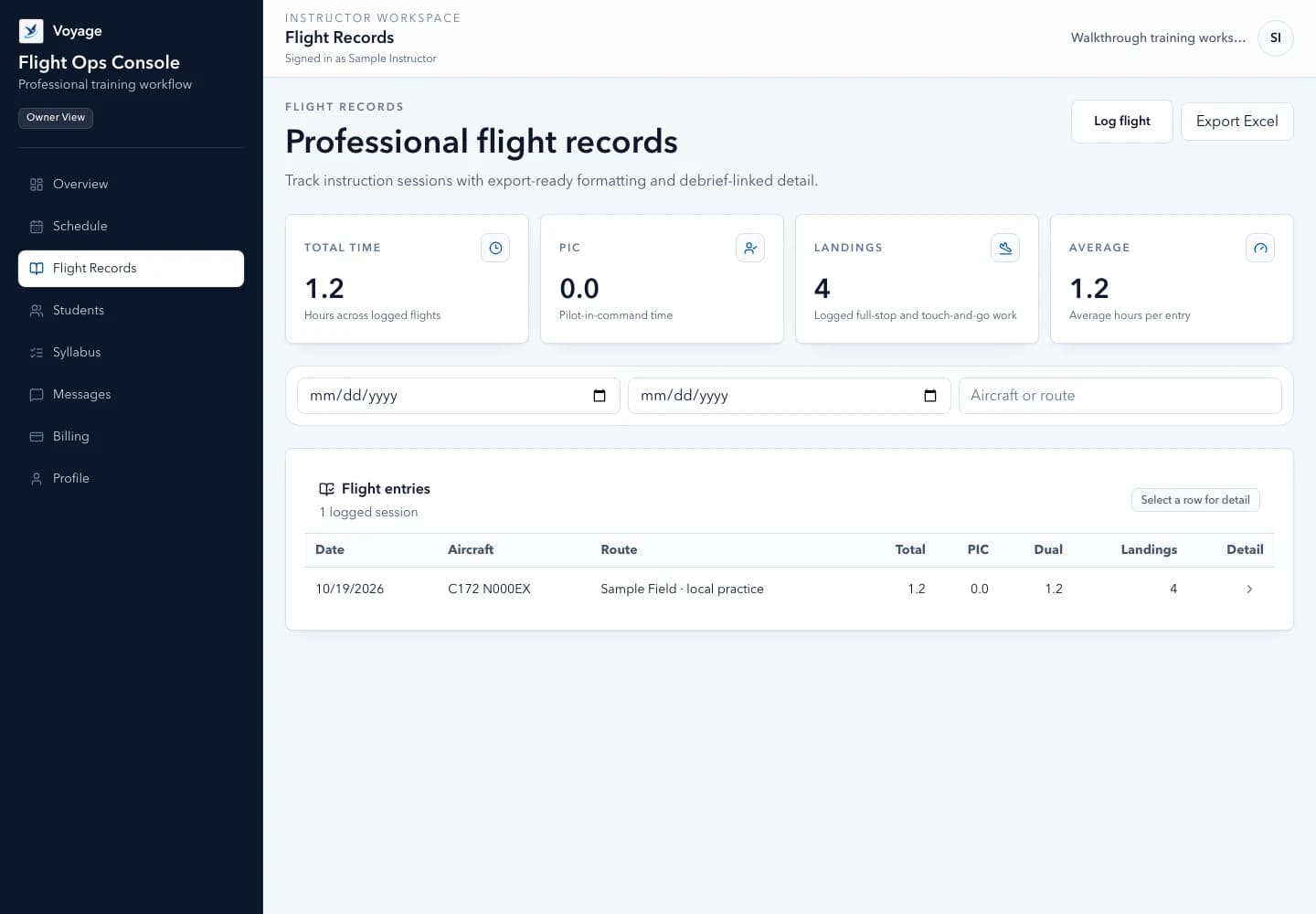
Connect completed lessons to structured evidence, debriefs, preparation, and instructor-defined syllabus progress.
Explore the product workflowPublished and maintained by Voyage. Read how Voyage researches, updates, and corrects its resources.